
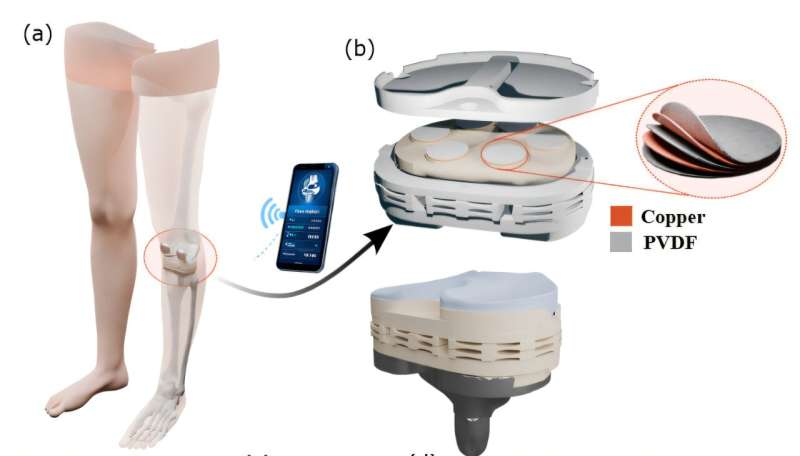
Professor Shahrzad “Sherry” Towfighian—a faculty member from the Thomas J. Watson College of Engineering and Applied Science’s Department of Mechanical Engineering—has worked toward “smart-knee” tech over the past decade.
According to the American College of Rheumatology, nearly 800,000 total knee replacements are done every year in the U.S., and that number is expected to rise sharply by 2030 as the population ages and sports injuries become more common.
“These implants should last for the rest of their lives. They don’t want revision surgery, but one in five patients has loosening or imbalance in the joint,” Towfighian said. “We need to solve this issue, because right now there are no sensors inside the implant to show any indication of problems, and then it becomes too late to fix it. The ability to noninvasively measure loads using embedded sensors would enable earlier identification of aberrant loading and the development of treatment strategies.”