
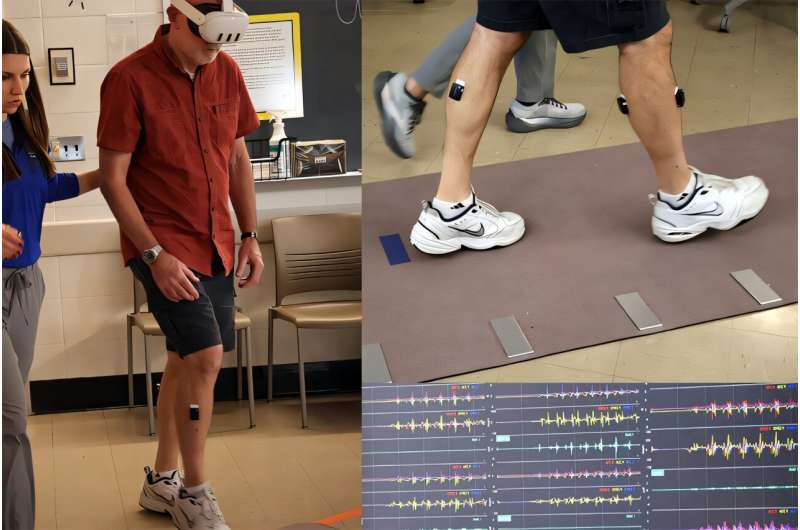
That’s the focus of a new study led by Rui Hua, an assistant professor in the department of biostatistics and health data science at Lehigh University’s College of Health (COH). An electrical engineer by training, Hua runs the Smart Wearable Electronics and hEalth daTa (SWEET) Research Group, which is focused on developing wearable and artificial intelligence (AI)-powered digital health solutions in neurorehabilitation and remote patient monitoring for Parkinson’s disease.
“We’re developing a virtual reality platform with the use of wearable sensors to objectively evaluate gait impairments and freezing of gait in patients with Parkinson’s disease,” explained Hua. Freezing of gait is a symptom of Parkinson’s that refers to a temporary, involuntary inability to move, as if the patient’s foot is suddenly “glued to the floor.” It can lead to falls, limited mobility and reduced independence or quality of life.