
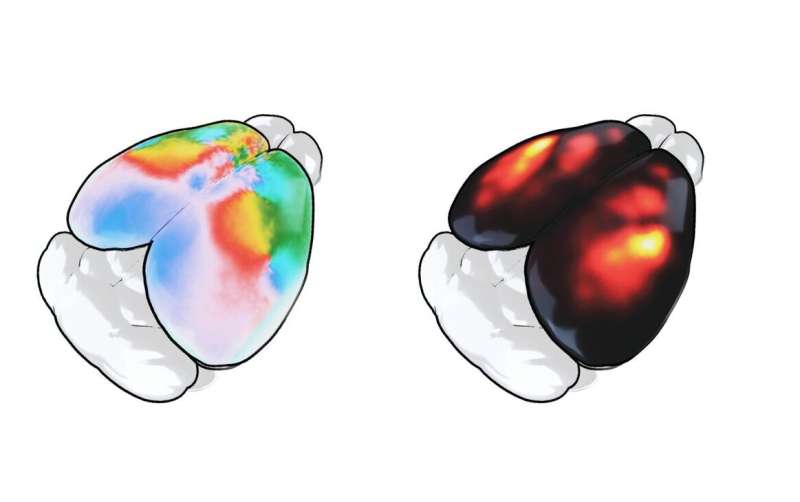
“We discovered a new kind of brain wave that specifically rotates over space and time, relies on a circular anatomical circuit in the sensory cortex, and impacts activity across the brain,” noted Nick Steinmetz, associate professor of neurobiology and biophysics at the University of Washington School of Medicine in Seattle. His team led the research.
Details on these traveling, whirling brain waves, as well as data on their activity during certain behaviors in mice, are reported in Science.
The findings on these vortex-like waves are, as they say, head-spinning.
The scientists examined how a mouse brain’s anatomical wiring coordinates the structure and propagation of the waves, which most commonly originate in the somatosensory region. This area processes sensations felt by the skin and muscles and cues about the body’s position, posture and parts, as well as other stimuli.