
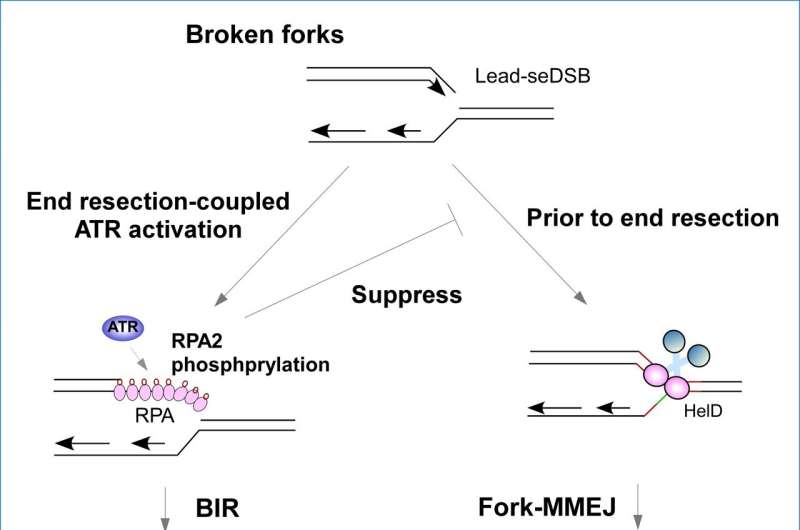
“We’ve uncovered a whole new dimension of how cancer cells cope with DNA damage at replication forks,” says Xiaohua Wu, professor at Scripps Research and senior author of the study.
Every time a cell divides, it must make an exact copy of its entire genome, a process carried out by molecular machinery that unzips the DNA double helix and reads each strand to build a new one. The point where this unzipping and copying actively happens is called a replication fork. But when this replication machinery encounters damage, forks can stall or collapse, leaving behind dangerous one-ended DNA breaks that are particularly difficult to repair and, if left unresolved, can kill the cell. This is particularly true in cancer cells, where replication stress is constant.