
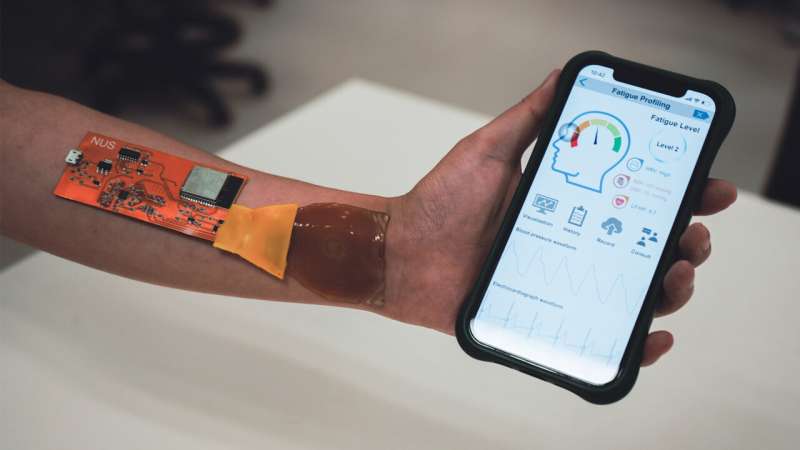
Wearable devices could fill the gap by continuously tracking cardiovascular markers linked to the autonomic nervous system, but their readings degrade sharply during everyday movement. Motion artifacts from muscle activity, body movement, and physiological interference overwhelm the faint heart and blood pressure signals these devices are trying to capture, and current mitigation strategies typically address only one type of noise or a narrow frequency band.
A research team led by Professor Ho Ghim Wei from the Department of Electrical and Computer Engineering under the College of Design and Engineering at the National University of Singapore, with Research Fellow Dr. Tian Guo, as first author, has developed a metahydrogel platform integrated with AI-driven signal processing that suppresses multiple sources of motion noise simultaneously.