
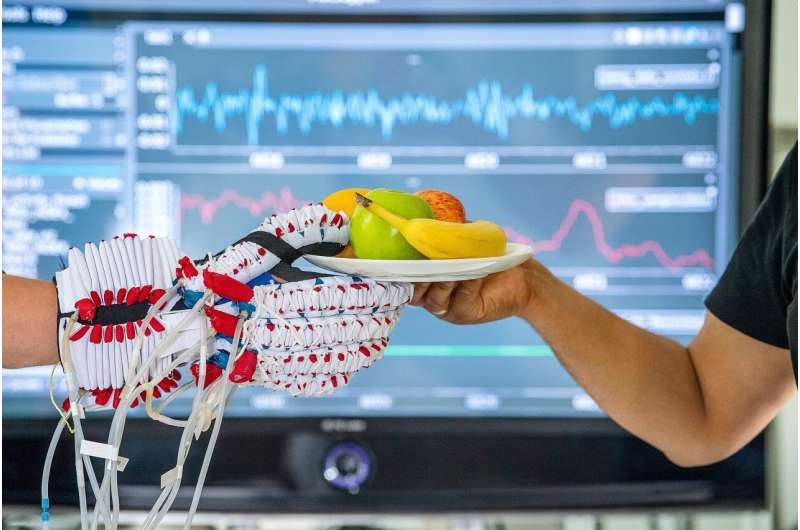
The “soft-hand exoskeleton” consists of a fabric glove developed by the researchers, with air cushions attached to its outer surface. The air cushions are inflated through a total of 13 tubes, providing targeted support for the hand movements needed to hold a plate or grasp a glass, fork or spoon. The air-filled cushions allow each finger to be bent and straightened individually while also rotating the wrist, enabling objects to be held securely in the hand.
To determine when a person intends to grasp an object, the researchers measure muscle activity in the forearm. Sensors attached to the forearm capture electrical signals, which are analyzed using machine learning to reliably determine the intended movement. “To prevent objects from being dropped accidentally, we use additional motion sensors to detect transport movements and keep the exoskeleton’s grip securely closed throughout the movement,” said researcher Nicolas Berberich.