
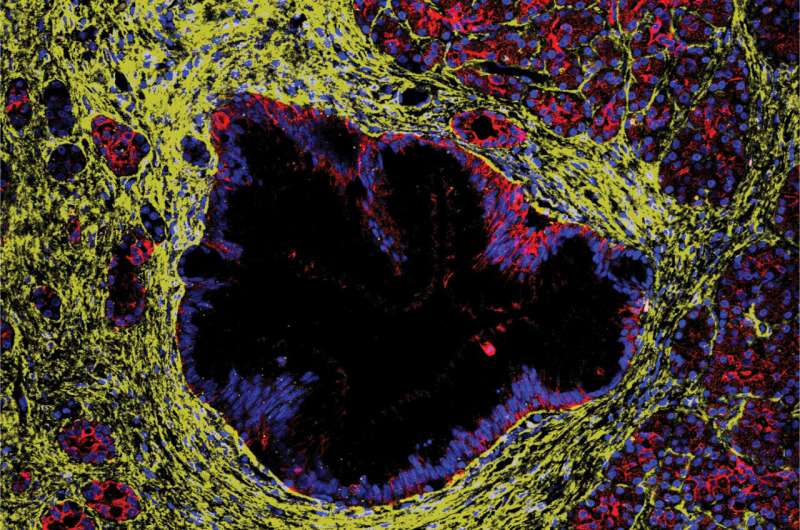
In an unexpected finding, a new study flips on its head researchers’ understanding of how precancerous pancreas lesions evolve into pancreatic cancer. The paradigm-changing discovery has tremendous implications for identifying people at higher risk of cancer or even, potentially, stopping malignant transformation.
In tumors, cancer cells induce surrounding non-malignant cells to become “helpers” and promote tumor growth. This is called the microenvironment. Precursor lesions called pancreatic intraepithelial neoplasia, or PanIN, similarly are surrounded by a collective of other cells
The precursor lesions express a similar set of genes as cancer cells but less strongly. So when researchers looked at the cells in the environment surrounding the lesions, they expected to see the same “tumor light” features. Surprisingly, the microenvironment of the precursor lesions was entirely different.