
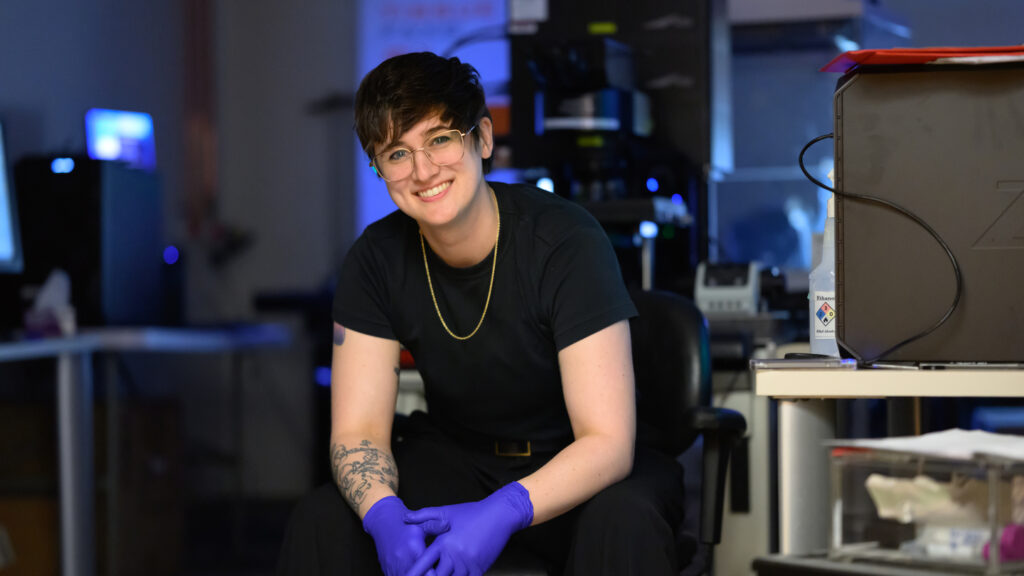
Shannon Knight attributes her interest in neuroscience to an experience she had in high school. She and her sister attended a medical day for students at the nearby University of Illinois Chicago. As they were on their way out of the event, they walked past a room with a person holding a brain.
“We stopped and backpedaled into the room, and I was so fascinated,” says Knight. “I was able to hold the brain of a patient who had passed away of Alzheimer’s. The brain holds so much emotion, decision-making — everything. I realized that this man’s entire memory was in my hands, and something clicked for me. I decided that I really wanted to learn much more about this organ.”
Now in her sixth year of doctoral studies at MIT’s McGovern Institute for Brain Research, Knight is working on developing a novel gene therapy for childhood-onset epilepsy, specifically SYNGAP1 haploinsufficiency. This rare genetic disorder is caused by a mutation in the SYNGAP1 gene, rendering one of the two copies of the gene nonfunctional.