
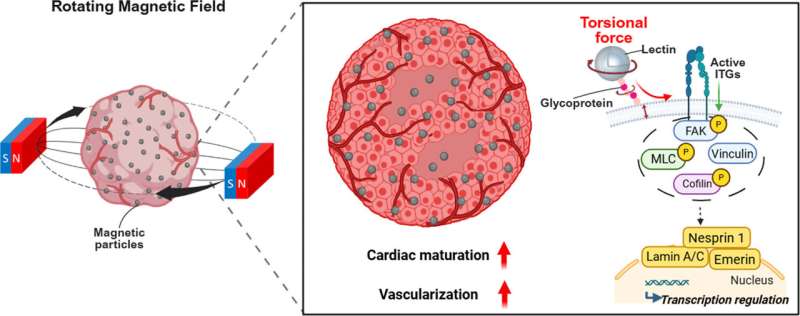
These challenges have fueled growing interest in regenerative medicine approaches that more accurately model human heart development, disease mechanisms, and therapeutic responses, with stem cell–derived cardiac organoids emerging as a promising platform.
Promise and limitations of cardiac organoids
These three-dimensional, self-organizing tissues recapitulate key aspects of early cardiac development and enable studies of congenital heart defects, drug-induced cardiotoxicity, and personalized therapies. Despite their promise, most cardiac organoids remain developmentally immature and poorly vascularized, limiting their translational relevance. This limitation arises from the fact that the mechanical forces essential for cardiac development in vivo are not sufficiently reproduced in organoid systems.