
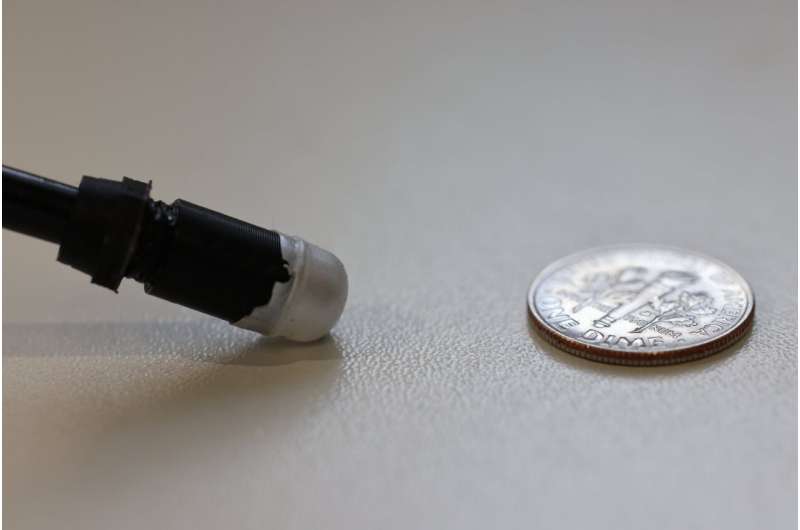
In contrast with open surgery, minimally invasive procedures are associated with less damage and faster recovery times. However, because surgeons cannot directly touch affected tissues with their fingers, they are typically unable to gather the same tactile information they would obtain during open surgery.
Researchers at Technische Universität Dresden (TUD), Stanford University and the Karlsruhe Institute of Technology developed MISTac, a high-resolution tactile sensor that could be used to collect touch-related signals inside the body. The sensor, introduced in a paper published as a preprint on arXiv, captures images of how its soft tip deforms upon contact with tissue. Artificial intelligence (AI) models could then analyze these images to estimate applied forces and distinguish among different tissues.