
Joana Carvalho, first author of the new study, who at the time was working in the Preclinical MRI lab led by senior author Noam Shemesh (she has since become a group leader at Coimbra University), “came up with the ideas, did the experiments and analyzed the results. I just brought the MRI expertise,” says Shemesh good-humoredly. Co-author Koen V. Haak from Tilburg University (Netherlands) gave assistance with the computational models and the others helped with the experiments.
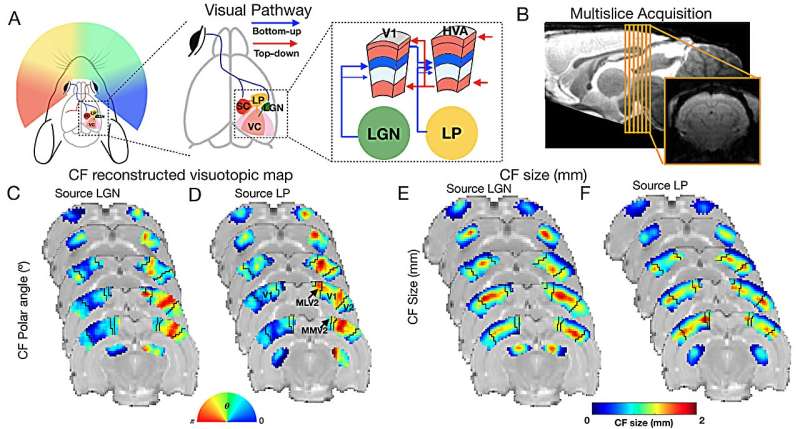
The team showed that spontaneous feedforward and feedback nervous impulses in these rodents (the brain never sleeps) each have a unique, distinct signature, which can be detected by using a method they developed, called uFLARE (UltraFast Layer-Resolved Encoding), a neuroimaging technique designed to map brain activity with unprecedented high temporal and spatial resolutions.