
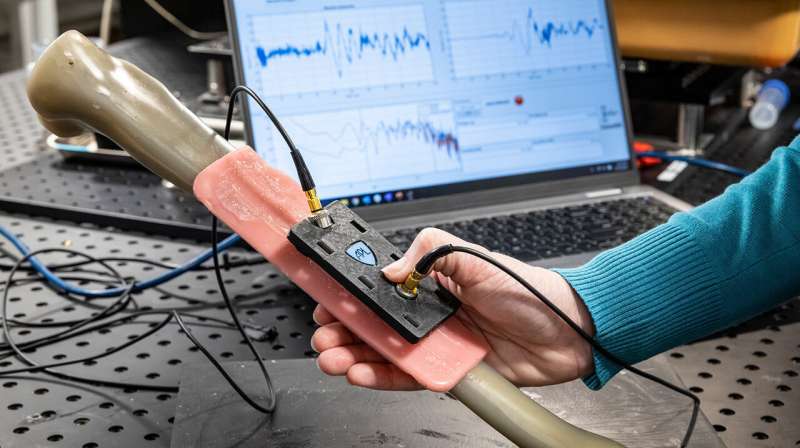
Researchers at the Johns Hopkins Applied Physics Laboratory (APL) in Laurel, Maryland, are developing Osteo Surface Echo Evaluation (OsteoSEE), a noninvasive, ultrasound-based platform that uses surface acoustic waves to identify microstructural changes and early-stage fractures in cortical bone—the dense outer layer of bone—avoiding the use of ionizing radiation. The technology was named a 2026 R&D 100 Award winner, recognizing its innovative approach to early fracture detection.
“One of the most compelling applications is supporting military readiness,” said Anna Knight, OsteoSEE principal investigator and a senior biomechanical engineer at APL. “Fully developed stress fractures can be disabling to individual warfighters, and the prevalence of this overuse injury limits mission readiness across the force.”