
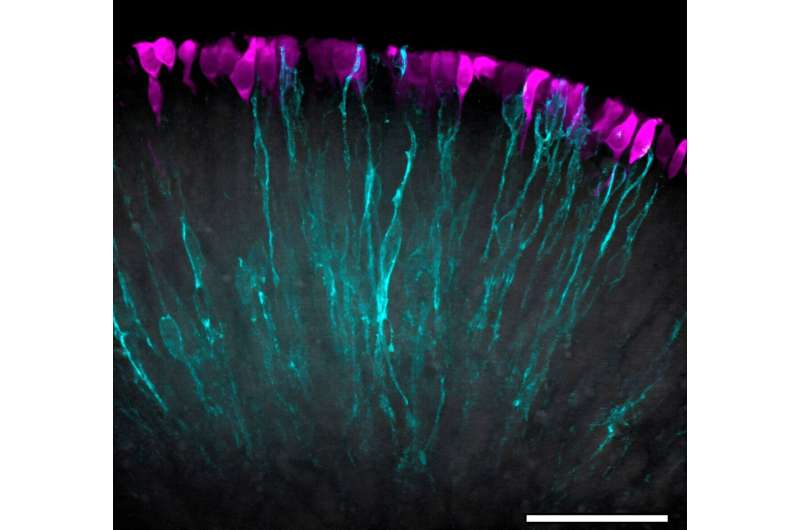
The international team led by Prof. Volker Busskamp at the University Hospital Bonn (UKB), the University of Bonn and the Institute of Molecular and Clinical Ophthalmology Basel solved this problem by combining human stem cell-derived retinal organoids with endothelial cells, which integrate into the organoids and create lumen-like networks that transport nutrients and oxygen—a crucial requirement for preserving sensitive retinal ganglion cells. In vivo, axons of retinal ganglion cells are forming the optic nerve and relay visual information from the retina to higher brain areas.
The paper is published in the journal Cell Stem Cell.
The scientists tested several methods for integrating the vascular cells and found that pre-cultured endothelial cells integrate best into already formed organoid spheres. This approach preserves developmental processes while significantly increasing the number of surviving ganglion cells. Analyses show that cell types in the vROs differentiate normally, while optic nerve cells survive longer and achieve higher functional maturity.