
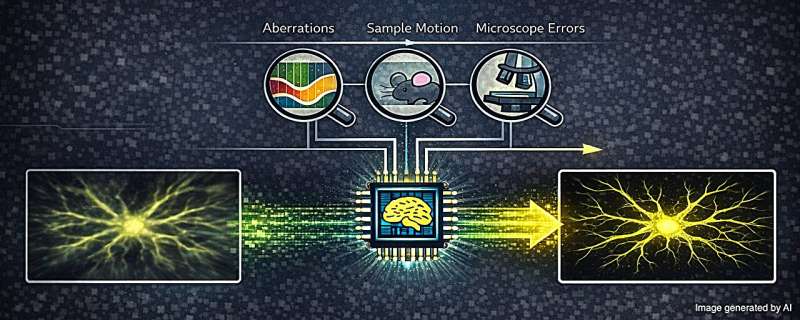
This was achieved using Neural Fields—a neural network-based technology that continuously represents 3D spatial structures to simultaneously reconstruct clear images and volumetric forms. The research is published in the journal Nature Methods.
The research team utilized two-photon fluorescence microscopy, a core technology for observing deep within living biological tissues by using two low-energy photons simultaneously to selectively illuminate specific points. However, as light passes through thick tissue, it bends and scatters, causing the image to become blurred—much like how objects appear distorted underwater. This phenomenon is known as optical aberration.