
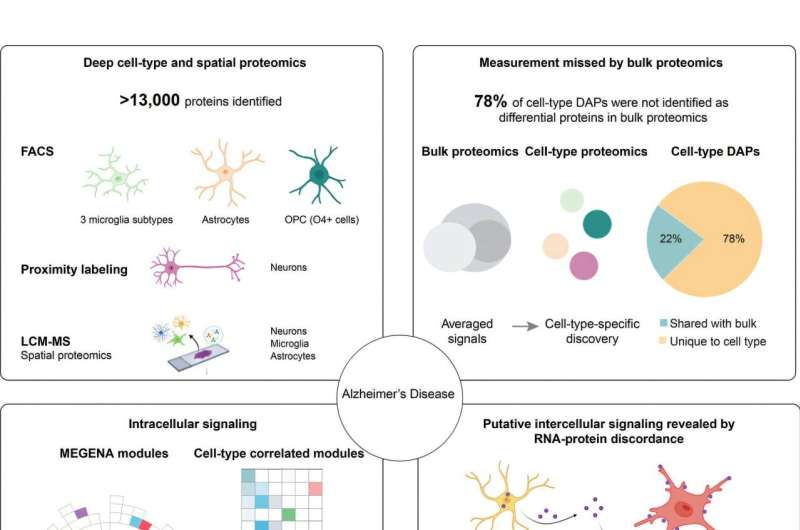
A focused look at microglia, which express many Alzheimer’s disease risk genes, revealed that almost all the changes to this cell type were previously undetected. The approach also uncovered a potential intercellular communication network, where proteins made in one cell type are secreted and function in another cell type. The findings, published in Neuron, provide much-needed cell type–specific context to the pathology of Alzheimer’s disease.
Single-cell RNA sequencing has revolutionized Alzheimer’s disease research, but it provides only a partial view of cellular activity. Proteomic profiling fills many gaps, but has largely been limited to bulk analysis, resulting in lost context. Now, by combining next-generation mass spectrometry methods with single-cell RNA sequencing and spatial omics, co-corresponding authors Junmin Peng, Ph.D., Departments of Structural Biology and Developmental Neurobiology, and Jiyang Yu, Ph.D., Department of Computational Biology interim chair, obtained the needed cell type–specific information.