
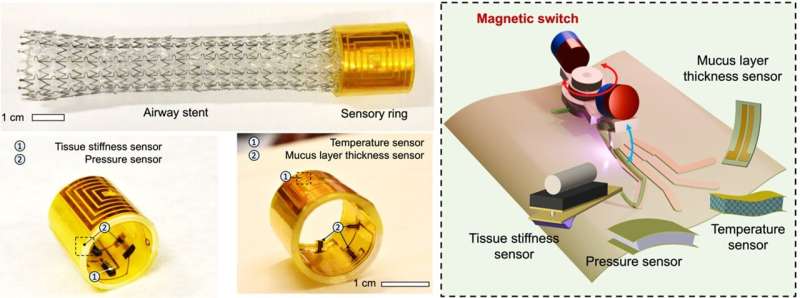
The research was published in Science Advances on April 15, with Mechanical Engineering Ph.D. student Yusheng Wang as the first author and co-authors from Vanderbilt University, Vanderbilt University Medical Center, and Texas A&M University.
Continuous wireless and minimally invasive monitoring of deep airway physiological properties outside the hospital is critical for enabling early detection of complications, reducing reliance on invasive bronchoscopies, and improving patient outcomes, researchers say. Airway diseases such as lung cancer and cystic fibrosis often progress silently, and real-time monitoring of tissue stiffness, pressure, mucus accumulation, or temperature can reveal issues before they become life-threatening.
Traditional methods using bronchoscopy or catheters typically require anesthesia, carry procedural risks, and do not provide longitudinal surveillance in daily life. To address these challenges, Dong and his team have created a device with multiple sensors and a magnetically controlled switch that can monitor a patient’s airway remotely.