
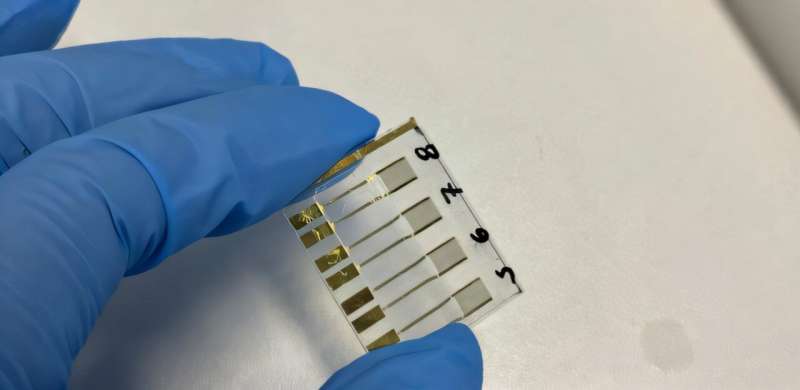
The device identifies the biomarker molecule CA19-9, which is associated with the disease, at low concentrations in a patient’s blood. This offers a simpler, more affordable alternative to conventional tests, which are less accessible. A paper describing this work appears in ACS Omega.
“In its early stages, pancreatic cancer is asymptomatic, which means the disease is often identified too late. That’s also why pancreatic cancer is one of the deadliest forms of cancer. So much so that in advanced cases, the five-year survival rate is only 3%. The idea of developing this cheap and simple biosensor stems from the principle of providing access to screening for the disease,” says Débora Gonçalves, a professor at the São Carlos Institute of Physics at the University of São Paulo (IFSC-USP) and project coordinator.