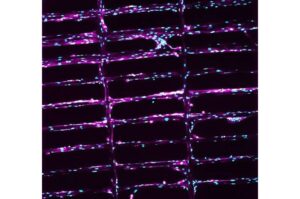
Promising drug can inhibit aggressive breast cancer
New research reveals a drug developed by scientists at Oregon Health & Science University may develop into a new treatment for an especially aggressive form of breast cancer.

New research reveals a drug developed by scientists at Oregon Health & Science University may develop into a new treatment for an especially aggressive form of breast cancer.

The saying goes that you should stay out of the kitchen if you can’t take the heat, but new research suggests otherwise—for the sake of your blood pressure.

Using these nanoparticles to deliver a flu vaccine, researchers observed an effective immune response at a much lower dose.

Eccrine sweat is a water-like fluid secreted by eccrine sweat glands that comprises various kinds of biochemical components such as electrolytes, metabolites, organic molecules, and drugs.

BraDiPho (Brain Dissection Photogrammetry) is an innovative tool for the study of white matter connections in the human brain. The realistic map was developed by a group of researchers from the University of Trento, the Provincial Healthcare Service of Trento, Fondazione Bruno Kessler and the Universities of Bordeaux and Sherbrooke.

Artificial intelligence (AI) and “protein language” models can speed the design of monoclonal antibodies that prevent or reduce the severity of potentially life-threatening viral infections, according to a multi-institutional study led by researchers at Vanderbilt University Medical Center.

Mayo Clinic researchers have developed a pioneering method to mend damaged hearts without open-heart surgery, an advance that could one day transform the treatment of heart failure.

A newly discharged American military veteran struggles emotionally to quiet memories from the battlefield. He smokes cannabis, increasingly, to fall asleep at night and to get through the day.

An Osaka Metropolitan University team has used stem cells extracted from adipose, the body’s fatty tissue, to treat spine fractures in rats similar to those caused by osteoporosis in humans. These cells offer the advantages of being easy to collect, even from elderly individuals, and causing little stress to the body, suggesting a noninvasive way of treating bone diseases.

Scientists have known for decades that opioids relieve pain by binding to molecular switches in the brain called mu-opioid receptors. What they didn’t know—until now—was exactly what happens next.