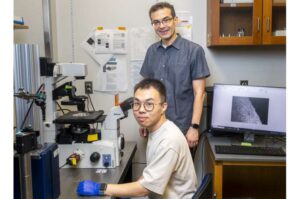
MIT engineers uncover a surprising reason why tissues are flexible or rigid
Watery fluid between cells plays a major role, offering new insights into how organs and tissues adapt to aging, diabetes, cancer, and more.

Watery fluid between cells plays a major role, offering new insights into how organs and tissues adapt to aging, diabetes, cancer, and more.

Scientists from the National University of Singapore (NUS) have developed NAPTUNE (Nucleic Acids and Protein biomarkers Testing via Ultra-sensitive Nucleases Escalation), a point-of-care assay that identifies trace amounts of disease-related genetic material, including nucleic acid and protein markers, in less than 45 minutes. Importantly, it accomplished this without the need for laboratory equipment or complex procedures.

A multidisciplinary team led by Professor Li Yulong from the School of Life Sciences at Peking University has developed a far-red fluorescent dopamine (DA) probe that enables real-time, multiplex imaging of neurotransmitters in the living brain.

The BiophysicaL Immune Profiling for Infants (BLIPI) profiles an infant’s immune system in under 15 minutes, using just a single drop of blood.

Scientists with the Fralin Biomedical Research Institute at VTC have created an engineered model of the supportive tissue found within a lymph node to study human health.

New research from SUNY Polytechnic Institute introduces an innovative, eco-friendly method to enhance the performance and longevity of titanium-based dental implants, focusing on improving the biocompatibility and mechanical resilience of Ti-6Al-4V alloy implants using hydroxyapatite (HA) coatings derived from biowaste.

A study published in Current Biology demonstrates that scientists can identify individuals based solely on their breathing patterns with 96.8% accuracy. These nasal respiratory “fingerprints” also offer insights into physical and mental health.

Researchers from Tel Aviv University and Sheba Tel Hashomer Medical Center have developed an innovative bioengineered skin equivalent for grafting in burn victims. The bioengineered skin produced from the patient’s own cells is more stable, robust, and flexible than current treatments, making it easier to handle.

A medical research team at Saarland University, led by Professor Bergita Ganse, has discovered a new approach to monitoring bone fracture healing by measuring blood supply to the tissue at the fracture site and the level of oxygen in the blood. Bone regeneration can be monitored quickly and easily using near-infrared light rather than harmful shorter wavelength radiation.

Each year, millions of people in the U.S. get dental implants as a long-term, natural-looking fix for missing teeth. But traditional implants don’t fully mimic real teeth.