
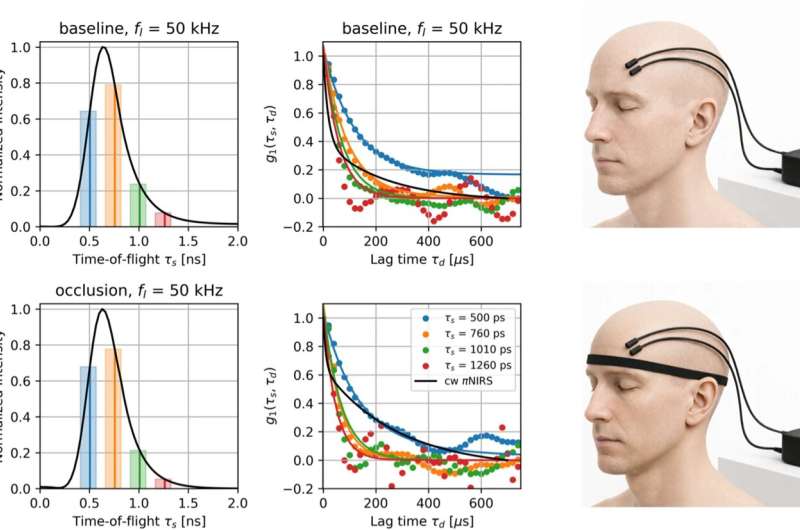
When blood flow is measured optically at the forehead, the detector receives mixed information. Some comes from circulation in the scalp, while some comes from deeper tissues. This makes it difficult to determine what an observed change really tells us about the brain’s blood supply.
The problem was investigated by Marcin Marzejon, Ph.D., Eng., who previously worked at the International Centre for Translational Eye Research (ICTER) at the Institute of Physical Chemistry of the Polish Academy of Sciences, and Dawid Borycki, Ph.D., DSc, leader of the PICO group. Their paper “Hybrid interferometric near infrared spectroscopy (hybrid iNIRS) enables time-of-flight–resolved non-invasive blood flow monitoring in humans in vivo” is published in Scientific Reports.