
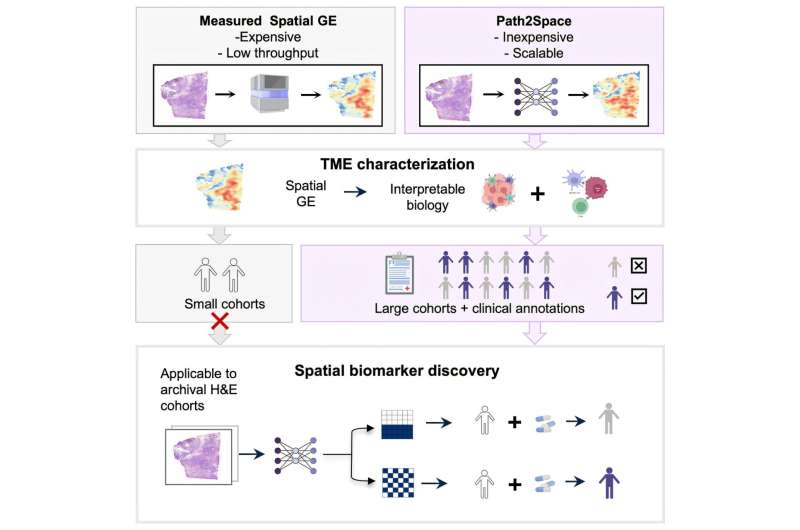
The new tool, called Path2Space, predicts gene expression across the tumor area based on digital images of biopsy slides, which contain thin slices of tumor tissue that can be examined under a microscope.
Because tumors do not have the same composition and gene expression throughout, Path2Space predicts what is known as “spatial” gene expression, estimating it at many different points within the tumor. The process takes only minutes and costs significantly less than conventional spatial gene expression profiling, which typically takes several weeks and costs thousands of dollars.
“This tool makes two major contributions,” said Eytan Ruppin, MD, Ph.D., deputy director of the Translational Research Institute at Cedars-Sinai and senior author of the study. “It will enable us and others to study larger datasets and understand the spatial structure of tumors. But what really motivates me is that, if we can successfully validate the tool in clinical trials, it could improve cancer care for patients.”