
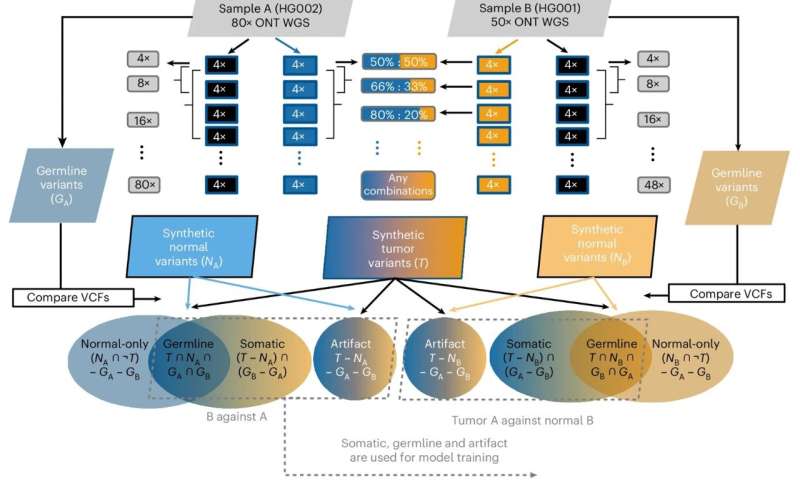
The team was led by Professor Ruibang Luo, assistant director of Learning Experience & Student Enrichment and associate head of the Department of AI & Data Science at the School of Computing and Data Science (CDS) at HKU. The findings are published in the journal Nature Methods. ClairS is open source and available on GitHub.
Training around scarce data
Cancer mutations are genetic changes found in tumor cells but not in healthy cells; detecting them accurately is essential for cancer research and precision medicine. However, many existing methods are designed for short-read sequencing and often struggle to analyze structurally complex regions of the human genome. ClairS addresses this challenge by using long-read sequencing to reveal mutations that might otherwise be missed.