
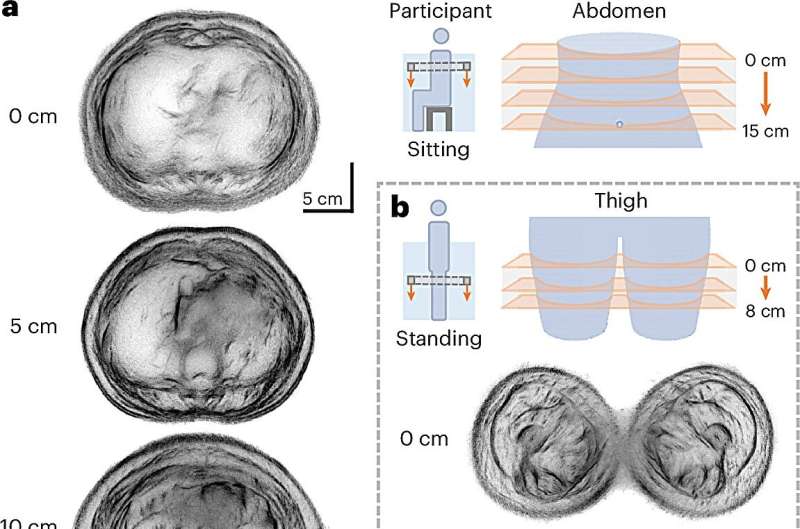
Ultrasounds are a critical part of modern health care, helping to image soft tissue and organs, measure blood flow, and monitor fetal development. But the technique has constraints, including a limited field of view and the potential for operator error.
“Much like a standard whole-body X-ray, MRI, or PET scan, our system is operator independent. It offers a large field of view because you see the entire cross-section and it doesn’t compress the tissue, which can cause distortion,” says Wang, who is also the Andrew and Peggy Cherng Medical Engineering Leadership Chair and executive officer for medical engineering at Caltech. “Plus, ultrasound is entirely harmless to patients, which is a big advantage over techniques that use ionizing radiation.”
The team’s novel whole cross-section UST system is explained in a paper published April 24, 2026, in Nature Biomedical Engineering.