CSR secures certifications in EU and Singapore for Sentire system
The CE certification confirms compliance with regulatory standards for safety, efficacy, and quality management.

The CE certification confirms compliance with regulatory standards for safety, efficacy, and quality management.

Neurovalens announced today that it received FDA de novo approval for Modius Spero, a post-traumatic stress disorder (PTSD) therapy.

Researchers from the National University of Singapore (NUS) have developed an AI-guided workflow that combines artificial intelligence (AI) with molecular simulations to identify potential drug candidates for diabetic wound healing, identifying folic acid, a common vitamin, as a top candidate.

Detecting melanoma before it becomes visible is a major challenge in dermatology. Now, with researchers from Université de Montréal, scientists at Université du Québec’s Institut national de la recherche scientifique (INRS) have developed a promising solution.

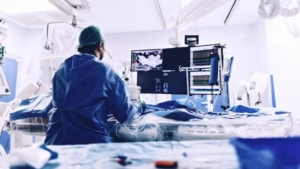
Cornerstone Robotics announced today that it received CE mark approval for its Sentire endoscopic surgical robotic platform.

In a study published in Nature Communications, the researchers found that the EXO1 gene is overexpressed in 20% to 30% of breast and ovarian cancers as well as in melanoma, testicular, cervical, and hepatobiliary cancers, which develop in the liver, gall bladder, and bile duct

Researchers at Penn State have developed a reusable material designed to solve both problems at once. The material is a thermoreversible semiconducting ionic biogel, meaning it becomes liquid when gently heated so it can move through hair and reach the scalp, then returns to a stable gel as it cools, keeping its conducting and semiconducting character.

Thanks to special 3D-printed scaffolding trays designed by experts at Cincinnati Children’s, researchers can now produce larger versions of functional human gut organoids twice as fast as previous methods—and these organoids grow their own nerve cells.

Zimmer Biomet (NYSE:ZBH) announced today that it received FDA 510(k) clearance for an advanced version of its Rosa Shoulder System.

Yanggang Feng and colleagues designed a lightweight (0.96 kg) wearable knee robot to assist isokinetic training for children with SMA type II, an intermediate form of the condition. In a clinical trial, they tested outcomes in six children (aged 6–10 years old) who could not stand from a seated position without assistance.