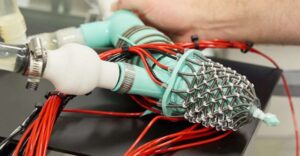
Artificial lung system keeps patient alive without lungs until transplant
Humans can’t live without lungs, but Ankit Bharat’s patient did for 48 hours.

Humans can’t live without lungs, but Ankit Bharat’s patient did for 48 hours.

A team led by researchers at Chalmers University of Technology, Sweden, has succeeded in identifying biomarkers for Parkinson’s disease in its earliest stages, before extensive brain damage has occurred. The biological processes leave measurable traces in the blood, but only for a limited period.

Pulsed-field ablation, transcatheter heart valves, and intravascular lithotripsy are among the top stories, as they drive growth among the largest cardio device companies.

Extracellular vesicles (EVs) are tiny particles shed by cells that carry important molecular “clues” about the cell’s identity and condition.

An Italian study published in Nature Medicine provides compelling evidence that fecal microbiota transplantation (FMT) can enhance the effectiveness of immunotherapy in patients with advanced metastatic renal cell carcinoma (mRCC).

University of British Columbia researchers have engineered gut bacteria that dim their fluorescent glow in the presence of illness. Their findings could improve how we diagnose problems in the gut by using bacteria that already live there. The work appears in Cell.

A Japanese research team has discovered a new compound that can advance the body’s internal clock—offering hope for faster recovery from jet lag and better adaptation to night-shift work.

New research reveals how Parkinson’s spreads from the gut to the brain, with the help of immune cells—offering a new potential therapeutic strategy—in a study in mice led by scientists at the UK Dementia Research Institute at UCL (University College London).

Fecal microbiota transplants (FMT) can dramatically improve cancer treatment, suggest two groundbreaking studies published in the Nature Medicine journal.

A new nano-sized drug carrier that finds bone tumors and releases treatment exactly where it’s needed is here to improve the precision and comfort of cancer therapy.